
2022-10-09 00:39 Economic Daily/ Yang Hailan
In order to accelerate the deployment of renewable energy, promote the overall carbon reduction effect, and respond to the industry’s requirements for the use of green electricity, China has implemented the green electricity certificate system since 2017, officially opening the application market of green electricity, which has become the most important tool in the process of low-carbon industry in China.
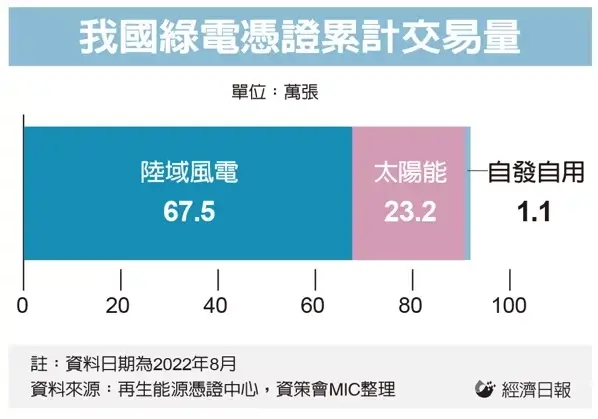
According to the Renewable Energy Voucher Center, from 2017 to March 2022, more than 1 million certificates were issued, equivalent to 1.064 billion kWh of renewable energy power generation, of which about 918,257 certificates (about 918 million kWh) were traded, with the largest onshore wind power with a total capacity of 330 MW (megawatts) of installations, and a total of more than 670,000 certificates were issued. The power generation capacity is 675 million kWh, and more than 230,000 certificates have been issued for the transfer of 110MW of solar photovoltaic installations, with a total power generation of about 232 million kWh, and the renewable energy devices for self-consumption can also be sold separately, with a cumulative transaction volume of about 11,000 kWh.
In 2021, the amendment to the Renewable Energy Development Regulations was completed, and enterprises “large electricity consumers” (with a contracted capacity of more than 5,000kW with Taipower) must bear the green power obligation of more than 10% of their contracted capacity, which can be achieved through self-construction of green power or energy storage equipment, purchase of green electricity certificates or payment of fees. The promotion of the “Large Electricity Consumers Clause”, coupled with the “greening” requirements of the international supply chain, has become the acceleration engine for the carbon reduction transformation of China’s industry.
The demand for green electricity of Chinese enterprises mainly comes from four driving forces: the international supply chain, in response to the requirements of international brands such as Google and Apple, suppliers are committed to using local green electricity; Under the terms of large electricity consumers, electricity users with a contracted capacity of more than 5,000 kilometres are required to set up renewable energy with 10% of the contracted capacity; Voluntary commitments, such as RE100, ESG and other corporate green initiatives, promote enterprises to move towards sustainable development and adopt green electricity; According to the requirements of the EIA committee, enterprises need to set up a certain proportion of green electricity.
In 2020, Greenpeace launched the “RE10x10” initiative to encourage enterprises to use/build green electricity, and corporate members who join must commit to converting at least 10% of their electricity consumption to green electricity by 2025. So far, 52 companies have joined, four have reached the 10% green electricity target, eight have started using green electricity, and 13 have committed to 100% renewable energy by 2050.
According to the annual report published by RE10x10 in 2022, enterprises reported that there are still several areas for improvement in the system and market of green electricity use in China, including the lack of understanding of the use and acquisition of green electricity; Enterprises with multiple users of a single battery number have difficulties in obtaining green electricity; The leased electricity site cannot purchase or install renewable energy power generation equipment on its own; The price of green electricity is high and opaque, and it is not easy to estimate the cost; The supply of green electricity is insufficient, and power generation companies mostly sell to Taipower through a wholesale purchase system.
Under the Renewable Energy Development Ordinance, power generators are free to choose whether to sell electricity to Taipower at a single purchase price, enter a green power trading platform for matchmaking, or enter into a power purchase agreement (PPA) with users to sell green electricity.
For renewable energy power generation operators, signing long-term corporate power purchase contracts (CPPAs) with enterprise users can ensure stable profits; For enterprises, CPPA can protect the price of green electricity and reduce the risk of future electricity price fluctuations on their operations. However, in practice, small and medium-sized enterprises (SMEs) have weak bargaining power and unstable operating status, and renewable energy power generation companies tend to sign CPPAs with large enterprises in order to ensure profits.
At present, the largest green power transaction in China is onshore wind power, with a single purchase price of about 2~2.6 yuan/kWh. The wholesale purchase price of solar photovoltaics is about 4~5.9 yuan/kWh (111 year price, excluding subsidies and markups), so the willingness of the industry to sell solar photovoltaics is low, and according to the RE10x10 annual report, the green electricity sold in the market includes other transmission and distribution and operating costs in addition to the power purchase cost of the electricity seller, and the final price may be 8 %至20% higher than the single purchase price.
China is actively developing offshore wind power and solar photovoltaics, but the supply of green electricity entering the market in the short term is still limited, so before a large number of offshore wind power can be connected to the grid in 2025, China’s green power will still be a seller’s market, and small and medium-sized enterprises may have to pay a higher cost to obtain green electricity.
The Energy Bureau of the Ministry of Economic Affairs plans that the capacity of offshore wind power installations will reach 5.6GW (1 billion watts) in 2025, and a large number of green electricity will be connected to the grid. Large-scale release of wind power is an option.
As the market expands, there is a greater need for an immediate and efficient green electricity trading mechanism, which means that the green power market will gradually loosen and develop in a more liberal direction. At the same time, electricity sellers play the role of matching supply and demand, and as the government rolls out more green electricity market-friendly policies, many green electricity sellers are also using technologies such as AI and big data to help customers optimize green power procurement and reduce residual electricity. If the green power market develops further, there may even be power trading mechanisms such as the day before and month before the island in the future, which is expected to give rise to more green power products and business models, creating another wave of green business opportunities. (The author is an industry analyst at the Institute for Information Technology’s MIC
****************************************************************************************************
Circle Plus Investment provides office, storefront, residential, factory, shopping mall, restaurant, land leasing and buying and selling services, please call 02 7730 0811.
****************************************************************************************************
Join The Discussion